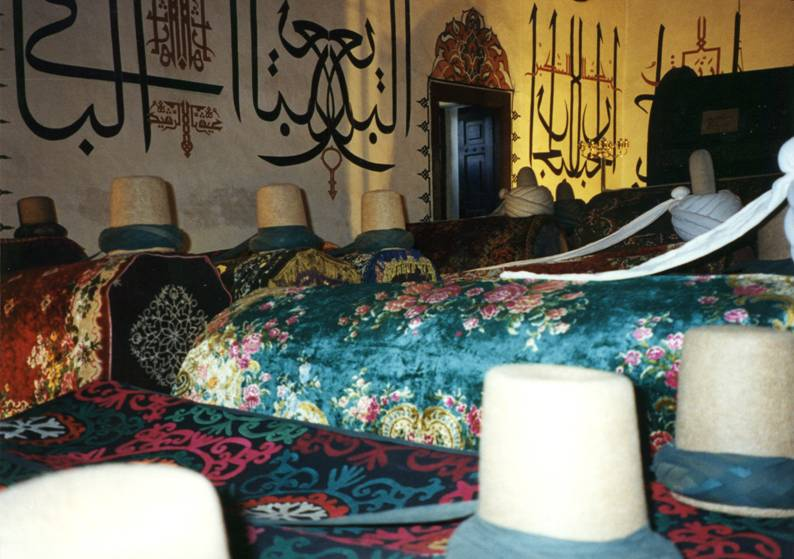
The religion of Islam took root in two forms in all the countries that adopted this faith. The first is formal, legal and dogmatic, and orthodox in constitution. These procedures were carried out by the Madrasa (religious school), and the Ulamas (doctors of sacred law and theology). The second form is the popular, mystic and intuitive faith of the people. On the whole, the latter has a heterodox constitution, and includes Dervish Brotherhoods. The first form usually becomes the formal State religion, while the second remains in opposition.
The Alevi-Bektashi and the Mawlawiyya are religious orders to be dealt with later. They are establishments rooted in SUFISM, some of which retain legacies from other more ancient religions. They are based on religious foundations brought about by the need to alleviate the harsh verdicts of the Shari’a, and organize religious life style through mysticism, to determine moral standards and develop the relationship between State and Community.
TASAWWUF is Islamic mysticism, also known as Sufism. In Islam, it is a way of life, of faith and of thought that aspires to achieve direct knowledge of Allah. The Sufi Muslim seeks a close, personal union with Allah. The word ‘Sufi’ is thought to derive from the Greek word Sophos (knowledge) or from the Arabic word Suf (the simple woollen garment worn by early ascetics). ‘Fuqara’, plural of ‘faqir’, means “the poor”, and is also a name applied to the Sufis. Their way of life can be summarised as follows: to trust in God in all circumstances, to be resigned to accepting uncomplainingly suffering and misfortune for the purification and refinement of the soul, to fear God, to love God beyond all limits and to shun sin and all that bears the taint of sin. Sufism is defined as a spiritual journey towards God. In both practice and teaching, the difference between a Sufi and a non-Sufi Muslim is to be found in the interpretation and expectation implicit behind the form of belief. The Sufi believes that there are profound spiritual truths underlying the literal rules and regulations written in the Holy Koran, and these should be interpreted mystically and intrinsically.
Faşizm, eşitsizliği meşrulaştırır. Alman asıllı Amerikalı milyarder girişimci Peter Thiel’in (1967-) “doğal hiyerarşiler” teorisi, zenginlik…
Madhubani sanatı, Hindistan'ın Bihar Eyaleti’nin kuzey kısmı ile Nepal'in doğu bölgelerini kapsayan tarihi ve kültürel…
Hegel için antik Yunan coğrafyası, Sokrates’i ile Oedipus ve Antigone’si ile özgür ve uygar birey…
“Derin bir hasret çekiyorlardı. Orada ne işleri vardı? Öylesine özlemini çektikleri şey doğdukları kent değil,…
“Daire günde 118 avroya, kısa dönemli olarak kiralanıyor; bu fiyata vergi dairesi İrlanda'da bulunan Fransız…