

UNESCO World Heritage Sites Listing Criterion (ii):
“…An outstanding example of the influence of an innovative transportation system on the social and economic development of a multi-cultural region, which was to serve as a role model for similar developments in many parts of the World.”
UNESCO World Heritage Sites Listing Criterion (iv):
The development of railways in the 19th century had a profound influence on social and economic developments in many parts of the World. This process is illustrated in an exceptional and seminal fashion by the Darjeeling Himalayan Railway (DHR).
Until the year 1878, when the Northern Bengal State Railway was open to traffic, the route from Calcutta to Darjeeling took from 5 to 6 days and was about as exhaustable and uncomfortable a journey as well be imagined.

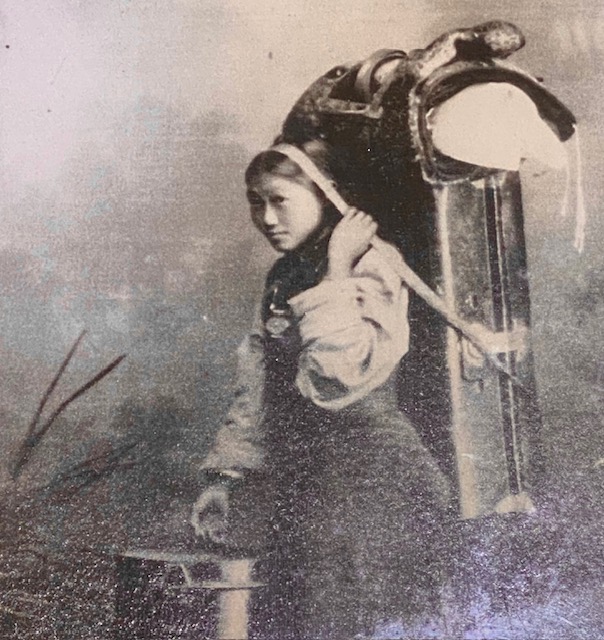
Once the train had arrived at Darjeeling, the early passengers had to negotiate terms with ‘coolie’ girls such as this for the transfer of their luggage to the hotel.

One of the main difficulties faced by the DHR was the steepness of the climb. Features called loops and Z-reverses were designed as an integral part of the system at different points along the route to achieve a comfortable gradient for the stretches in between them.
In a loop, the train is made to gain height by the track circling round and passing over itself by tracing the natural contours at the end of a spur of a hill.
When the train moves forwards, reverses, and then moves forward again, climbing a slope each time while doing so, it gains height along the side of a hill. This is called a Z-Reverse.

Photo: Fest Group, Darjeeling, 2026.
The building and the precincts of the station is under restoration. This will be followed by a permanent museum where the visitor can revisit the past of the DHR, and restoration of station buildings.
Source: The information gathered from the site.


Leave A Reply