

From the second half of the 4th millennium BC, the so-called Kura-Araxes Culture spread throughout the eastern part of the Southern Caucasus. Known today as the Transcaucasian Kura-Araxes Culture, it is associated with the highly significant beginnings of the Bronze Age in the Caucasus. No other Caucasian culture has ever been as widely diffused as the Kura-Araxes Culture. Lasting for nearly a thousand years between the second half of the 4th millennium and the first half of the 3rd millennium BC, the Kura-Araxes Culture was diffused to most of the southern part of the Caucasus (apart from the coastal area), the north-eastern Caucasus, north-west Iran, the eastern part of Anatolia, and even Syria and Palestine. The Kura-Araxes Culture was one of the most widespread cultures of the Near East at the time.
Georgia was one of the principle cradles of the Kura-Araxes Culture, with its own local variants. It was to be found over almost the whole of present-day Georgia, apart from the Kolkheti lowlands. All elements and stages in the development of the Kura-Araxes Culture have been identified at sites in inner Kartli.
Innovations can be observed in several areas: there are new architectural concepts, with most buildings rectangular with a corridor and a room leading off that might contain a round figured hearth set in the clay floor and whose roof might be supported by a main pillar. These novelties were attested by excavations carried out in the 20th century. Here wattle and daub buildings containing hearths and occupying 70 sq. m were found.

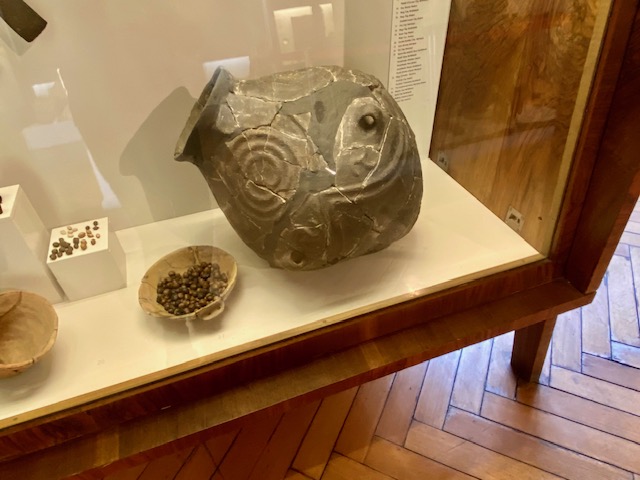

Clay vessels. First half of the 3rd millennium BC.
Photos: Füsun Kavrakoğlu, Tbilisi, 2025.
Other new elements are to be observed in pottery production (hand-made pottery with red or black polished surface, decorated in relief or with incised spiral or geometric patterns), or in farming with the introduction of the plough. There were new elements too in other spheres of economic life, notably in the metallurgy that was a highlight of the Kura-Araxes Culture. A high level of metal processing (especially of copper and copper-arsenic alloys) is reckoned to be its main technical and cultural achievement, as reflected in the production of tools and weapons, and of various forms of personal ornament. Among personal ornaments worn as status symbols noteworthy are the diadems of copper alloy found in women’s graves. Compositions, reflecting beliefs concerning fertility and cosmogony, are embossed on the diadems.
Of Caucasian provenance are three stylistically similar diadems, as well as other metal artefacts, found together in the royal grave of Arslan Tepe. Lead, silver, as well as a copper alloys containing antimony or arsenic, a novel element for the period, were used for the production of personal ornaments. Moulds, bellows, nozzles, crucibles, the remains of blacksmiths’ workshops and of kilns for the smelting of ores at certain sites bear witness to local metalwork production. Only four workshops of this period are known in the Caucasus; two are in Azerbaijan, while the other two are in Georgia. Tribes belonging to the Kura-Araxes Culture played a distinguished role in the development of metallurgy. Finds of gold artefacts dated to the Kura-Araxes Culture were few.
Information panels of Georgian Museum of Fine Arts in Tbilisi.

Leave A Reply