
Karaims settled in Trakai in the end of the 14th century. The official date of Karaites migration to Trakai is 1397-1398. The Grand Duke Vytautas of Lithuania after his victorious march to the Black Sea brought from Crimea 380 Karaim families to serve as his loyal guards and brave soldiers and settled them in Trakai. After settling in Lithuania, Karaims formed a separate community, called djymat (cemaat). Later, other Karaim settlements grew in Northern Lithuania: in Birzai, Pasvalys, Naujamiestis, Upyté. However, Trakai has always been their administrative and spiritual center. The Grand Duke Vytautas granted them some privileges. In 1441, Grand Duke Casimir, granted Magdeburg Rights to the community. It was the first time in Lithuania for Magdeburg Rights to be granted to a non-Christian community.
The right of self-governance which was administered and managed by the Vaitas (the Chief of the community), who would be elected at the General Meeting by and from the members of the community. The Vaitas had the judicial and decision-making power, and resided almost always in Trakai.
The privileges approved by Polish kings and Lithuanian dukes, till the third division of the Commonwealth of Two Nations in 1795, the Trakai Karaim self-governance and Vaitas lost their rights. Crimean Karaims experienced a similar fate when, in the second half of 18th century, the Crimean Khanate, which had until then been an Ottoman vassal entity and had been ruled by the Giray Khans, was also annexed to the Russian Empire.
Having become one state, Lithuanian and Crimean Karaims started jointly taking care of their legal status.
In 1863, Tsar Alexander II passed a special decree whereby Karaims became recognized as fully equal with the local population.
At the beginning of the World War I, Karaims, like most residents, had to withdraw into the depths of Russia. When they returned home in 1919-1920, they were bound to live in two states: in Lithuania (Panevezys, Pasvalys, Birzai, Talackonys) and in Poland (Trakai, Vilnius, Lutsk, Halych). All Lithuanian and Polish Karaims were subordinate to Religious Board of Trakai Karaims.
When the Soviets came into power and closed all Kenesas. After the annexation of Lithuania in 1940, the activities of the Religious Board of Trakai Karaims were terminated, Kenesas and schools were closed and nationalized, all Karaim organizations and press were banned. Practically, all religious life went underground.
In 1992, the Government of the Republic of Lithuania granted the rights of a legal entity to the Karaim community and restored its independence. The Lithuanian Constitution recognizes Karaism as one of nine traditional religions in Lithuania. In 1988, Vilnius Kenesa was returned to the community; in 1993, religious service has been rendered there again. At present, the Lithuanian Karaim community has no priest. Six readers interchangeably render religious service in Trakai and Vilnius Kenesas.
Several dozen of Karaim families still live in Trakai. They have retained their language and customs. In Trakai, the Karaims also owned land, so called Royal Fields. Each family cultivated their own part of that farmland that they had no right to sell. After the death of the owner, the plot was transferred to another family by the community decision.
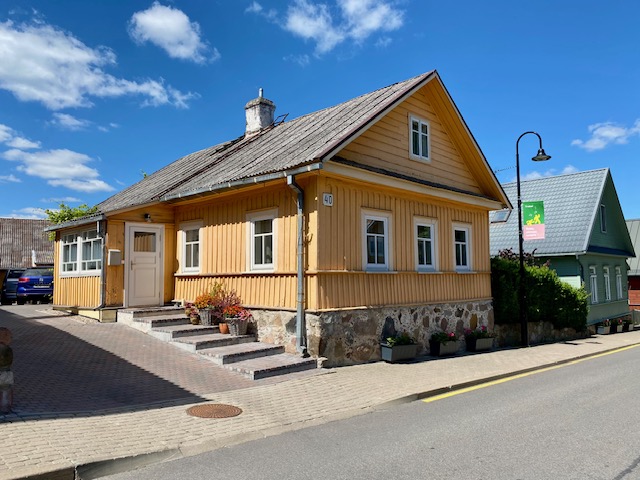
The houses of Trakai Karaites stand in a compact territory. For a long time, this part of the town was called the Little Town. The Karaites houses are easy to distinguish: mostly, they are standing endwise with three windows to the street side.
Photo: Füsun Kavrakoğlu, Trakai, Lithuania, 2026.
Kenesas, Halina Kobeckaité, Vilnius, 2019.
Information panels of Karaites Ethnographical Exhibition, Trakai, Lithuania.


Leave A Reply